The exclusive legal rights granted by a government to an author, editor, compiler, composer, playwright, publisher, or distributor to publish, produce, sell, or distribute copies of a literary, musical, dramatic, artistic, or other work, within certain limitations (fair use and first sale). Copyright law also governs the right to prepare derivative works, reproduce a work or portions of it, and display or perform a work in public.
- Copyright Clearance Center, Inc. (CCC)
- The largest licenser of photocopy reproduction rights in the world, CCC was established in 1978 by a group of authors, publishers, and users of copyrighted material in an effort to facilitate compliance with U.S. copyright law. CCC manages the rights to over 1.75 million works and represents approximately 9,600 publishers and hundreds of thousands of individual authors and creators.
- Copyright Clearance Center, Inc. (CCC)
- In 1710, the first copyright law in England gave protection to the author for 14 years, renewable for a second period of equal length. In the United States, the first federal copyright law, passed in 1790, also provided protection for 14 years, renewable for an additional 14 years if the author survived the first term. Congress extended the term in 1831 and 1909, then changed the duration of copyright to life of the author plus 50 years, effective January 1, 1978. In 1998, the controversial Copyright Term Extension Act (CTEA) lengthened the period to life of the author plus 70 years for works published on or after January 1, 1978, the same as in Europe. For anonymous works, pseudonymous works, and works for hire the period is 95 years from year of first publication or 120 years from year of creation, whichever expires first. Library and consumer groups including the American Library Association (ALA) filed amicus briefs in support of a challenge (Eldred v. Ashcroft), but on January 15, 2003 the U.S. Supreme Court upheld the CTEA by a 7-2 vote. Copyright is controlled by Congress and administered by the U.S. Copyright Office of the Library of Congress (click here to see the U.S. Copyright registration of L. Frank Baum's The Wonderful Wizard of Oz). International copyright is governed by the Berne Convention and the Universal Copyright Convention.
- copyright compliance
- The responsibility of a library to ensure that its interlibrary loan requests, reserve materials, instruction guides, Web pages, etc., conform to existing copyright law. In the OCLC interlibrary loan system, the codes ccg ("conforms to copyright guidelines") and ccl ("conforms to copyright law") are used by the borrowing library to inform the lending library that a request is compliant.
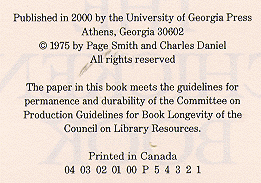
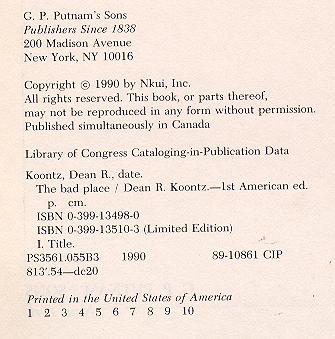
The year in which a work was first published, usually printed in the copyright notice on the verso of the title page, sometimes following the letter "c" with a circle around it (see this example). If more than one copyright date is given, the earliest is the date of the first edition, which is the same as the date of first publication. Subsequent dates indicate revisions in the text of an extent requiring renewal of copyright.
- copyright depository
- A library designated by law or custom to receive and preserve a specified number of free deposit copies of works published under national copyright law. In the United States, the copyright depository is the U.S. Copyright Office at the Library of Congress. In Great Britain it is the Bodleian Library. In Canada, copyright law is administered by the Canadian Intellectual Property Office (CIPO). Synonymous with copyright library.
- copyright fee
- The payment required by a national copyright depository to register copyright of a creative work, which must be submitted with the completed application form and a deposit copy of the work. Also refers to the fee that must be paid to the holder of copyright in exchange for the right to use all or part of a work in a manner not defined under U.S. copyright law as fair use, for example, the right to include a poem or short story in an anthology, or an excerpt or quotation in a published work. See also: permission.
- copyright holder
- The person(s) or corporate body possessing the exclusive legal rights granted by a government to publish, produce, sell, or distribute copies of a literary, musical, dramatic, artistic, or other work, within certain limitations (fair use), usually the author, editor, compiler, composer, playwright, publisher, or distributor. In the United States, such rights are granted by the U.S. Copyright Office when a work is registered for copyright. The name of the copyright holder is given in the copyright notice, usually printed on the verso of the title page of a book. Synonymous with copyright owner.
- copyright notice
- A formal announcement of legal status appearing conspicuously on all copies of a work protected by copyright and published by authority of the copyright owner. In the United States, it consists of three parts: (1) the symbol "c" inside a small circle © and the abbreviation Copr. or the word Copyright, followed by (2) year of first publication and (3) name of copyright holder. In printed books, the copyright notice appears on the verso of the title page (see this example).
- copyright page
- The page of a book, in most editions the verso of the title page, bearing official notice of copyright, usually the copyright symbol ("c" inside a small circle) or the word Copyright or its abbreviation (Copr.), followed by year of first publication, name of copyright holder, country of publication, and other notice and rights information (see this example).
- copyright piracy
- The systematic unauthorized reproduction or use, without permission and recompense, of a work protected by copyright law, usually for the purpose of profiting from such activity. This type of egregious infringement is subject to legal action by the copyright owner(s) in countries that have accepted international copyright agreements, but in countries that have not, the holder of intellectual property rights may have little recourse. See also: pirated edition.
- Digital Millennium Copyright Act (DMCA)
- Legislation passed by Congress and signed into law in October 1998 to prepare the United States for the ratification of international treaties protecting copyrights to intellectual property in digital form, drafted in 1996 at a conference of the World Intellectual Property Organization (WIPO). The bill was supported by the software and entertainment industries and opposed by the library, research, and education communities. Click here to learn more about the DMCA, courtesy of the Electronic Frontier Foundation (EFF). A summary is available from the U.S. Copyright Office at www.copyright.gov/legislation/dmca.pdf. See also: Technology, Education and Copyright Harmonization Act.
- International Copyright Information Centre (ICIC)
- A clearinghouse with headquarters in Paris, established by UNESCO in 1971 to offer assistance to publishers from developing countries in securing rights to books and other publications protected by copyright in other countries. See also: Copyright Clearance Center.
- international copyright
- Copyright protection extended to works published outside a country's borders, currently governed by national copyright law and international agreements, such as the Berne Convention and the Universal Copyright Convention.
- Technology, Education and Copyright Harmonization Act (TEACH)
- When the Digital Millennium Copyright Act of 1998 was debated, lobbyists and educators reached an impasse on new exemptions for digital distance education. Enacted in 2002 following five years of negotiations between educators and the publishing and entertainment industries, TEACH amends the DMCA to permit nonprofit, accredited educational institutions certain exemptions in the use of copyrighted materials. Under Section 110, educators and enrolled students are allowed to display or perform the entire text of a nondramatic literary work in the digital classroom without obtaining prior permission from the copyright holder and without paying fees, provided proper notice of copyright protection is given. Reasonable and limited portions of dramatic literary works, such as narrative motion pictures, operas, plays, etc., may also be used in the digital classroom.
- U.K. Copyright Service (UKCS)
- Stationer's Hall served as the central copyright registration office for the United Kingdom until the year 2000 when UKCS was launched as an independent witness agent, providing affordable and confidential copyright registration, secure storage of registered items, and information about the registration process and intellectual property laws and issues. UKCS maintains its own secure database of copyright registration records. Click here to connect to the UKCS homepage. See also: Canadian Intellectual Property Office, U.S. Copyright Office, and World Intellectual Property Office.
- Universal Copyright Convention (UCC)
- An international copyright convention drafted in 1952 under the auspices of UNESCO, revised in 1971 and ratified by over 65 countries, including the United States. Under its terms, each signatory nation extends to foreign works the same copyright protection it gives to works published within its territory by one of its own citizens. Click here to read the Universal Copyright Convention as revised at Paris on July 24, 1971. See also: Berne Convention.
- U.S. Copyright Office (USCO)
- The agency of the U.S. federal government responsible for administering copyright law, a unit of the Library of Congress. Although the first federal copyright law was passed in 1790, copyright functions were not centralized under the Library of Congress until 1870, and the Copyright Office did not become a separate department of the Library of Congress until 1897. In addition to administering federal law protecting the intellectual property rights of American citizens, the Copyright Office also provides expertise to Congress on matters related to intellectual property, advises and assists Congress in drafting proposed changes in U.S. copyright law, advises Congress on compliance with international copyright agreements, serves as a depository for works registered under U.S. copyright law, and furnishes information to the general public on copyright law and registration. Click here to connect to the homepage of the U.S. Copyright Office. See also: Canadian Intellectual Property Office, U.K. Copyright Service, and World Intellectual Property Office.


No comments:
Post a Comment